Chem 2 Acid and Base Titration Exam Review
Tabular array of Content
- What is Acid-Base Titration?
- Recommended Videos
- Theory
- Key Terms
- Types
- Titration Curve
- Indicator
- Solved Example
- Frequently Asked Questions – FAQs
What is Acrid-Base Titration?
An acid-base titration is an experimental technique used to acquire information virtually a solution containing an acrid or base.
Hundreds of compounds both organic and inorganic can be adamant by a titration based on their acidic or bones properties. Acrid is titrated with a base and base is titrated with an acid. The endpoint is usually detected past adding an indicator.
Recommended Videos

Learning Objective
To decide the concentration of an acid or base by measuring the volume of titrant (of known concentration) that reacts with it according to a stoichiometric proton-transfer reaction.
Theory
An acid-base of operations titration involves potent or weak acids or bases. Specifically, an acrid-base titration can exist used to figure out the following.
- The concentration of an acrid or base
- Whether an unknown acid or base is potent or weak.
- pKa of an unknown acrid or pKb of the unknown base.
Let united states consider acid-base reaction which is proceeding with a proton acceptor. In water, the proton is usually solvated as H3O+. HiiO is added to the base to lose (OH–) or gain (HthreeO+). Acid-base reactions are reversible.
The reactions are shown below.
HA + H 2 O → H 3 O + + A – (acid)
B – + H 2 O → BH + OH – (base of operations)
Hither [A–] is the conjugate base of operations, H+B is cohabit acrid. Thus we say
Acid + Base ⇋ Conjugate base + Conjugate acid
Hence
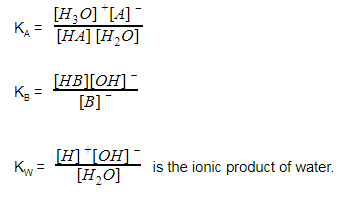
It is possible to give an expression for [H+] in terms of KA, 1000B and 1000w for a combination of diverse types of strong and weak acids or bases.
Fundamental Terms
- Titration – A procedure where a solution of known strength is added to a certain volume of a treated sample containing an indicator.
- Titrant – A solution of known force of concentration used in the titration.
- Titrand – The titrand is any solution to which the titrant is added and which contains the ion or species being determined.
- Titration curve – A plot of pH Vs millilitres of titrant showing the manner in which pH changes Vs millilitres of titrant during an acid-base titration.
- Equivalence point – The point at which simply adequate reagent is added to react completely with a substance.
- Buffer solution – A solution that resists changes in pH even when a strong acrid or base is added or when information technology is diluted with water
Types of Acid-Base Titration
The types and examples of stiff/weak acids and bases are tabulated below.
| S.No | Types | Examples |
| 1. | Strong acid-strong base | Hydrochloric acid and sodium hydroxide |
| 2. | Weak acid-strong base of operations | Ethanoic acid and sodium hydroxide |
| 3. | Potent acid-weak base of operations | Muriatic acid and ammonia |
| 4. | Weak acid-weak base | Ethanoic and ammonia |
Titration Curve & Equivalence Point
In a titration, the equivalence point is the point at which exactly the same number of moles of hydroxide ions have been added as there are moles of hydrogen ions. In a titration, if the base is added from the burette and the acid has been accurately measured into a flask. The shape of each titration curve is typical for the type of acrid-base of operations titration.
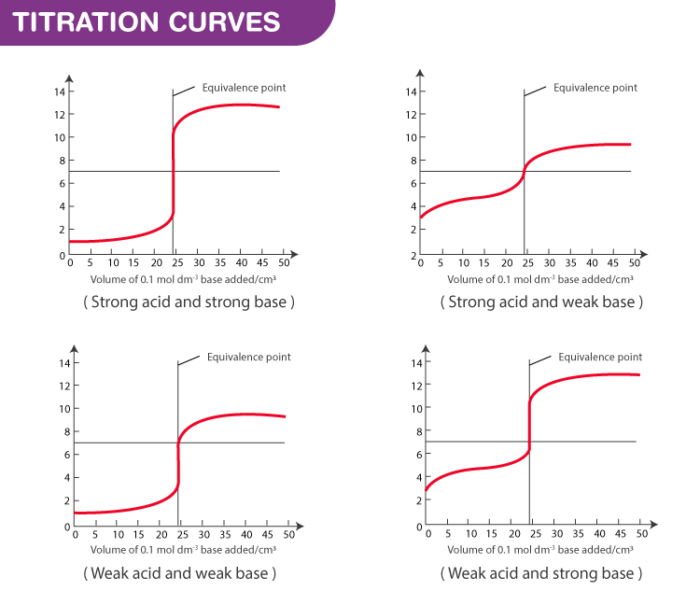
Titration Curve with Equivalence Point
The pH does non change in a regular manner as the acid is added. Each bend has horizontal sections where a lot of bases can be added without changing the pH much. There is also a very steep portion of each curve except for weak acid and the weak base where a single drop of base of operations changes the pH by several units. There is a large modify of pH at the equivalence indicate even though this is not centred on pH vii. This is relevant to the choice of indicators for each blazon of titration.
Pick of Indicators
Acrid-base indicators are substances which alter colour or develop turbidity at a certain pH. They locate equivalence indicate and likewise measure pH. They are themselves acids or bases are soluble, stable and show strong colour changes. They are organic in nature.
A resonance of electron isomerism is responsible for colour modify. Diverse indicators have different ionization constants and therefore they show a change in colour at different pH intervals.
Acid-base indicators can be broadly classified into iii groups.
- The phthaleins and sulphophthaleins (eg; Phenolphthalein)
- Azo indicators (eg; Methyl orange)
- Triphenylmethane indicators (eg; Malachite light-green)
The 2 common indicators used in acid-base titration is Phenolphthalein and methyl orange. In the four types of acid-base titrations, the base is existence added to the acid in each case. A graph is shown below where pH against the volume of base added is considered. The pH range over which the two indicators change colour. The indicator must change within the vertical portion of the pH curve.
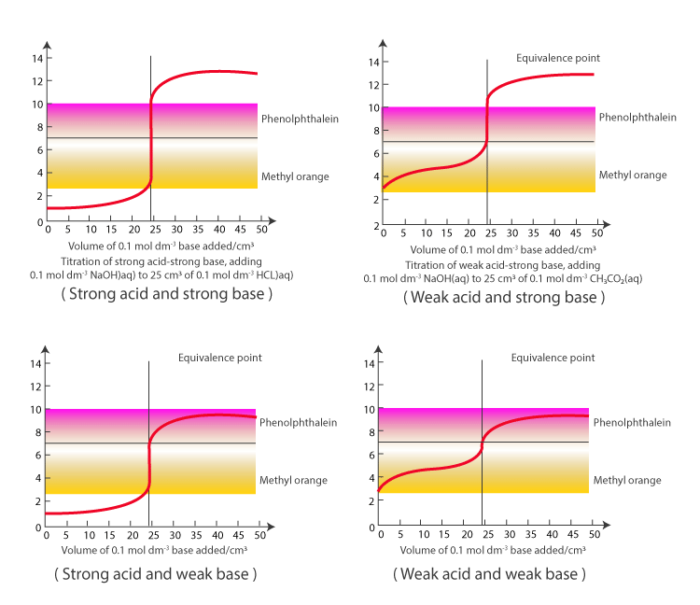
pH Range Over which the 2 Indicators Change Colour
The Choice of indicators based on the type of titration is tabulated below.
| Types of titration | Indicators |
| Stiff acid-strong base | Phenolphthalein is usually preferred considering of its more easily seen color change. |
| Weak acid-stiff base | Phenolphthalein is used and modify sharply at the equivalence point and would be a skilful choice. |
| Strong acrid-weak base of operations | Methyl orangish volition change sharply at the equivalence point. |
| Weak acid-weak base of operations | Neither phenolphthalein, not methyl orange is suitable. No indicator is suitable because it requires a vertical portion of the curve over two pH units. |
Solved Example
Trouble:
A 1.2gm sample of a mixture of (Na2COiii + NaHCOthree) is dissolved and titrated with 0.5N HCl. With phenolphthalein, the endpoint is at 15ml while subsequently further add-on of methyl orange a second endpoint is at 22ml. Summate the percentage limerick of the mixture.
Solution:
xv + 15 = 30ml acid is necessary to neutralize Na2COthree completely.
Total book needed = 15 + 22 = 37ml
(37-30) = 7ml acrid is needed for neutralizing NaHCO3
Therefore, Na2COthree composition (%) is
= [(xxx x 0.5 x 0.053)/1.2] x 100 = 66.25%
= (7 x 0.5 x 0.042 10 100) / 1.2 = 24.50% NaHCO3
Frequently Asked Questions – FAQs
Why is acrid base titration important?
The purpose of a strong acrid-strong base titration is to determine the acid solution concentration by titrating it with a bones solution of known concentration, or vice versa until there is neutralization. The reaction between a strong acid-base and a stiff base will, therefore, event in water and table salt.
What are the applications of acid-base titration?
An acid-base titration is used to determine the unknown acid or base of operations concentration by neutralizing it with an acid or a known concentration footing. The unknown concentration can be calculated using the stoichiometry of the reaction.
Which indicator is used in acid-base of operations titration?
Using a phenolphthalein indicator, a potent acid- strong base titration is performed. Phenolphthalein is selected because it changes color between 8.3-10 in a pH range. In bones solutions, information technology will appear pink, and clear in acidic solutions.
What are two acid-base of operations indicators?
Examples of acid-base indicators include red cabbage juice, litmus newspaper, phenolphthalein and. An acid-base indicator is a weak acid or weak base of operations which dissociates in h2o to produce the weak acid and its conjugate base, or the weak base and its conjugate acid. The species and their cohabit are of different colours.
Why phenolphthalein is colourless in acrid?
In nature, phenolphthalein is lowly acidic. And it dissociates itself into and ions in aqueous solution. The solution's pinkish color is due to the concentration of ions within the solution. The concentration of in the solution is very depression under acidic conditions and the concentration of is loftier, therefore it is colourless.
Source: https://byjus.com/chemistry/acid-base-titration/
0 Response to "Chem 2 Acid and Base Titration Exam Review"
Post a Comment